
Can enough of us trigger a course change to prevent ‘ecological collapse’?
Welcome to the manifesto website of a proposed organisation that aims to swiftly answer the question above.
If it is possible for enough of us to get on the same page and trigger such change, then it’s time to team up and get the job done.
While the Same Page Manifesto is relevant to everyone, its content is targeted at those already passionate about sustainability, regeneration, and economic transformation.
The manifesto is partially uploaded.
The manifesto was last updated on: 11 December 2025
While this web page contains a full introduction to the Same Page Manifesto, some of the other main pages are still being completed. None of the manifesto pages will be finalised until all six web pages are fully uploaded.
| Manifesto web pages | Status |
|---|---|
| Introduction | Complete (this page) |
| Challenges | Nutshell summary only |
| Approach | Nutshell summary only |
| Plan | Partially complete |
| Play you part | Partially complete |
| Supporting voices | Complete |
The content of each web page is described in the What you’ll find in the rest of the manifesto section at the bottom of this page.
Introduction sections:
- It’s time for us to change course
- It’s the global economic system that we most need to change
- As a focused, confident team, we can change all our global systems
- You can help to trigger the course change we all need
- What you’ll find in the rest of the manifesto
1. It’s time for us to change course
As most of us are already aware, and the graphic below illustrates, we have reached an existential fork in the road of human civilisation.
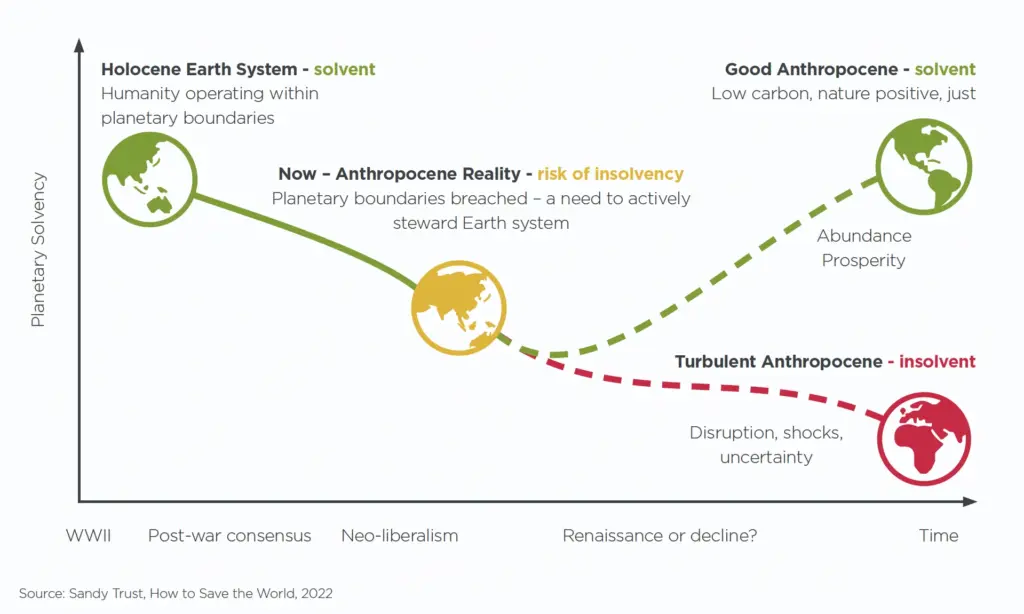
This is our plight. If humanity wants a ‘solvent’ future, then enough of us need to swiftly collaborate to trigger a course change.
2. It’s the global economic system that we most need to change
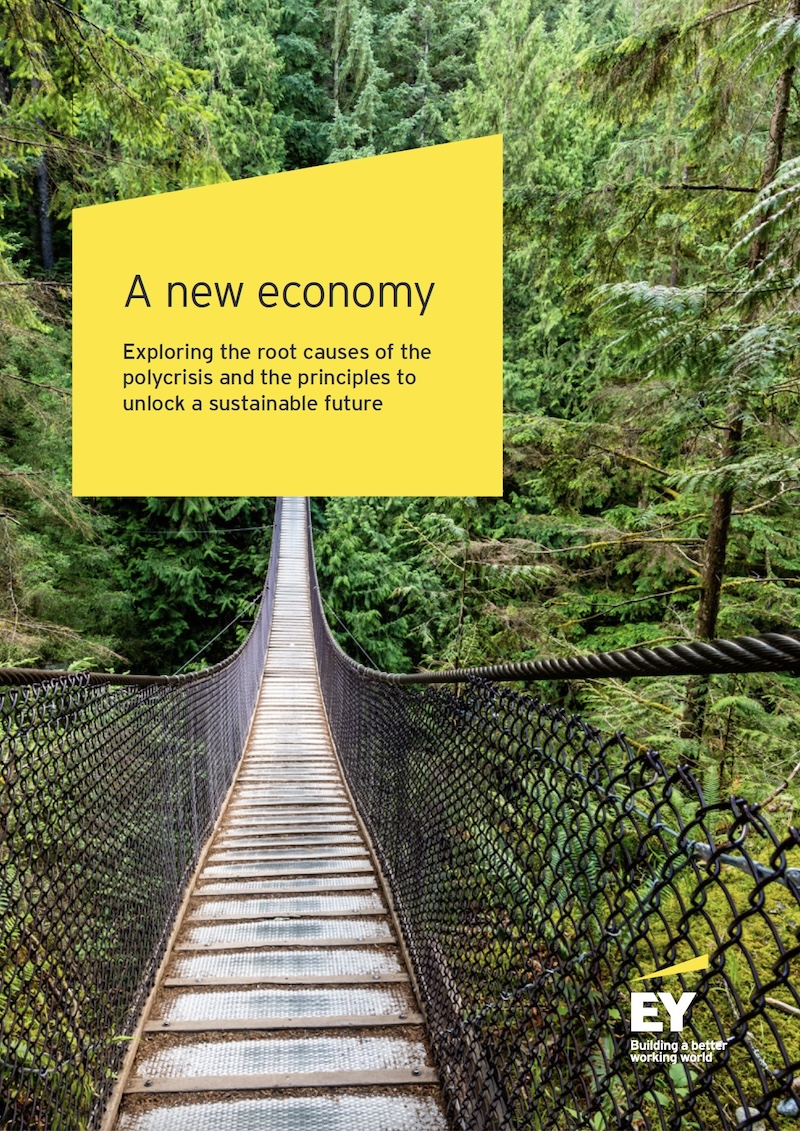
In May 2024, one of the world’s largest and most influential companies, EY, published a report that identifies the upstream cause of our plight.
Marked by increasing signs of ecological breakdown, deepening social inequality and rising geopolitical tensions, we find ourselves in the midst of a polycrisis. These causally entangled crises are the result of similarly interconnected structural flaws in the global economic system … Without urgent, large-scale transformation, it’s not a matter of if, but when, we’ll reach the point of ecological collapse.
A new economy: Exploring the root causes of the polycrisis and the principles to unlock a sustainable future, New Economy Unit, EY (May 2024)
So, what is it about our economic system that society needs to transform? Here’s EY’s list.1
| From ‘polycrisis economy’ flaws | To ‘new economy’ principles |
|---|---|
| unsustainable growth and overconsumption | sufficiency |
| linear economy | circularity |
| financial capital myopia and short-termism | value redefined |
| siloed thinking | systems thinking |
| inequality and injustice | equality and justice |
The From set are the ‘interconnected structural flaws’ driving today’s ‘polycrisis economy’. The To set are the guiding principles of the ‘new economy’ EY implores us to quickly transition to.
The flaws are ordered as they are in EY’s report, however, the root flaw is in the middle: financial capital myopia.
Our flawed behaviours are ultimately driven by this single-minded pursuit of evermore financial wealth — a construct, or tool, not a real thing like clean water we can drink — regardless of the changing impact on the direct forms of wealth (‘natural, human, social’, to again quote EY) that enable life.
As ‘Doughnut’ economist Kate Raworth eloquently summarises:
Today we have economies that need to grow, whether or not they make us thrive; what we need are economies that make us thrive, whether or not they grow.
Kate Raworth, Doughnut Economics (2017)
Of course, enhancing quality of life through economic growth was the original goal of today’s base economic system (as designed some 250 years ago), but the critical limits to that growth have been known and ignored for at least 50 years.
Every day of continued exponential [economic] growth brings the world system closer to the ultimate limits of that growth. A decision to do nothing is a decision to increase the risk of collapse.
Meadows, et al, Limits to Growth (1972)
Current economic theory fails to differentiate healthy development from cancerous growth.
Bernard Lietaer, et al, Is Our Monetary Structure a Systemic Cause for Financial Instability? Evidence and Remedies from Nature (Journal of Futures Studies, 2010, Vol.14(3), 89-108)
Are we simply incapable of shaking off this unhealthy addiction?
Surely not.
Seeking relentless economic growth even when it leaves us worse off is a system goal, not an immutable law: we can change it if we choose to.
But how do we actually change the goal and, thus, the impacts of the global economic system?
Could it be as simple as a group of us teaming up to confidently end mainstream support for the ‘cancerous growth’ of harm-causing business, whilst bolstering mainstream support for the healthy growth of business that enhances social and ecological wealth?
3. As a focused, confident team, we can change any global system
My name is Simon Hertnon and I have observed:
- Addressing our plight is humanity’s most important task because human life is dependent on ecological wellbeing.
- The upstream cause of our plight is the flawed global economic system because it drives the societal behaviours that cause ecological harm.
- Our key challenge is to overcome unnecessary busyness (driven by the economic system) because this busyness keeps us too dazed, distracted, and divided to clearly see or respond to our plight.
Crucially, I have also reasoned:
- We can overcome our debilitating busyness through a new approach that seeks to identify the fewest and simplest actions for addressing our plight.
- We can most swiftly arrest and address ecological degradation by teaming up to end harm-causing business (mass actions A1 to A4 below).
- We can mature our economic transformation and achieve wider societal wellbeing by collaboratively redesigning all our societal systems (mass action A5 below).
- We can expedite the progress of our response through coordinated global collaborations (expediting collaborations C1 to CP further below).
Five mass actions
Knowing that changing course requires a movement of mass participation — and that mass actions need to be limited in number to have any chance of being performed — here are five mass actions (A1 to A5) that can empower, start, and complete a swift course change.
| Action | Purpose |
|---|---|
| A1 Team up | To empower the course change |
| A2 Speak up | To simplify the course change |
| A3 Reject harm-causing business | To start the course change |
| A4 Prohibit harm-causing business | To strengthen the course change |
| A5 Reset societal systems | To complete the course change |
Each action will soon be fully outlined on the Plan page, but here’s a brief introduction to paint a picture.
| A1 Team up |
| Purpose To empower changing course through mass participation. Method By convening a massive global community of course-change supporters. Description Given sustainability’s shift ‘from margins to mainstream’2, right now enough of us could team up (as Team Humanity, or similar) to gain the power of numbers and cohesion. Through the democratisation provided by an online hub, team members could be from any country. |
| A2 Speak up |
| Purpose To simplify changing course by concertedly encouraging businesses and politicians to proactively participate in the movement. Method By widely publicising our team’s determination* to end support for harm-causing business; and by clearly communicating to businesses and politicians the practical actions they can take to join and support our popular movement. Description Focussing on the world’s wealthiest democracies, our team could then give notice to every business and politician that our custom and votes will only go to those whose actions support our collective rejection of harm-causing business, and to compellingly invite them to ‘get ahead of the curve’. |
* Backed by global surveys like the Earth for All Survey 2024 and the Global Commons Survey 2024 (both conducted by IPSOS) that show majority support in wealthy democracies for transforming the purpose of the global economic system.3
| A3 Reject harm-causing business |
| Purpose To start changing course without first needing to change ‘the system’. Method Through a global consumer movement of mass commercial boycotts powered by a simple prove-you’re-worthy-of-our-custom consumer awareness program. Description Next, we could exercise the enhanced power of our team’s combined social permissions to: – multiply support for helpful business that enhances social and ecological – continue support for harmless business – end support for harm-causing business |
| A4 Prohibit harm-causing business |
| Purpose To strengthen the course change through the simplest possible legal prohibition of harm-causing business. Method By providing one legal clause (prohibiting ‘any activity that results in systemic ecological, social, or intergenerational harm’, or similar) that political candidates must promise to add to the director’s responsibilities of their jurisdiction’s corporate law. Description During the 2026–2030 global cycle of democratic elections, we could also exercise the enhanced power of our team’s combined political choices to support only candidates who commit to prohibiting harm-causing business. |
| A5 Reset societal systems |
| Purpose To complete the course change by designing a fundamental reset of the goals of our societal systems (which currently all serve the blinkered pursuit economic growth). Method Through a global citizen-led program of system-redesign collaborations that are inspiringly transparent, participatory, respectful, joined-up, and efficient. Description By 2035, we could complete an essential redesign of our globally intertwined societal systems (trade, justice, health, education, etc) so, instead of effectively serving a critically-flawed economic system, they harmoniously and sustainably achieve the overarching societal purpose of delivering optimality for all. |
These mass actions could be termed the Supporter Actions, given they will be performed by supporters of a course change.
Seven expediting collaborations
To assist the general public to accomplish the Supporter Actions, those already working towards environmental and social betterment could also team up through seven expediting collaborations4.
| Collaboration | Purpose |
|---|---|
| C1 Mobilise Team Humanity | To expedite A1 Team up |
| C2 Organise societal change | To expedite A2 Give notice |
| C3 Reinvigorate social permissions | To expedite A3 Reject harm-causing business |
| C4 Protect survival systems | To expedite A4 Prohibit harm-causing business |
| C5 Redesign betterment systems | To expedite A5 Reset societal systems |
| CR Renew humanity’s wisdom | To inform all five mass Actions |
| CP Promote helpful information | To support all five mass Actions |
These seven collaborations could be termed the Expediter Collaborations, given they will be performed by individuals and organisations whose work expedites the Supporter Actions.
As one streamlined global program, this initiative would enable efficient, synergetic collaboration between thousands of similarly-motivated entities.
Three essential facilitations
Finally, to enable the Supporter Actions and Expediter Collaborations, an entity will need to perform three essential facilitations.
| Facilitation | Purpose |
|---|---|
| FS Simplify the overall task | To supply a simple action plan that seeds popular focus and generates enough belief (particularly among those already working towards sustainability, regeneration, and economic transformation) that changing course is achievable. |
| FP Provide essential information | To supply the essential information needed for mass engagement and participation in both the movement’s Supporter Actions and Expediter Collaborations. |
| FC Coordinate the Collaborations | To support the efficiency and effectiveness of the movement’s Expediter Collaborations and, as a consequence, the achievement of the Supporter Actions. |
These facilitations could be termed the Essentialist Facilitations, given the critical need for simple, stripped-back information that facilitates mass engagement.
For expediters: we need easy-to-consume information, like this report-style manifesto.
For supporters: we need even simpler, more concise information
I envisage the supporter information as a limited set of downloadable (A4/US Letter-sized) pages that are each:
- individually named
- expertly designed
- expertly translated (universally)
- strictly version-controlled
- Creative Commons licensed
So, one set of pages we can all consume, comprehend, trust, and share.
Given we are separated by hundreds of languages and distracted by overwhelming quantities of information, how else can enough of us ‘get on the same page’ about how to overcome our plight?
A role for everyone
Critically, this plan has a role for everyone, as anyone can be a supporter (and expediters and essentialists are already supporters).
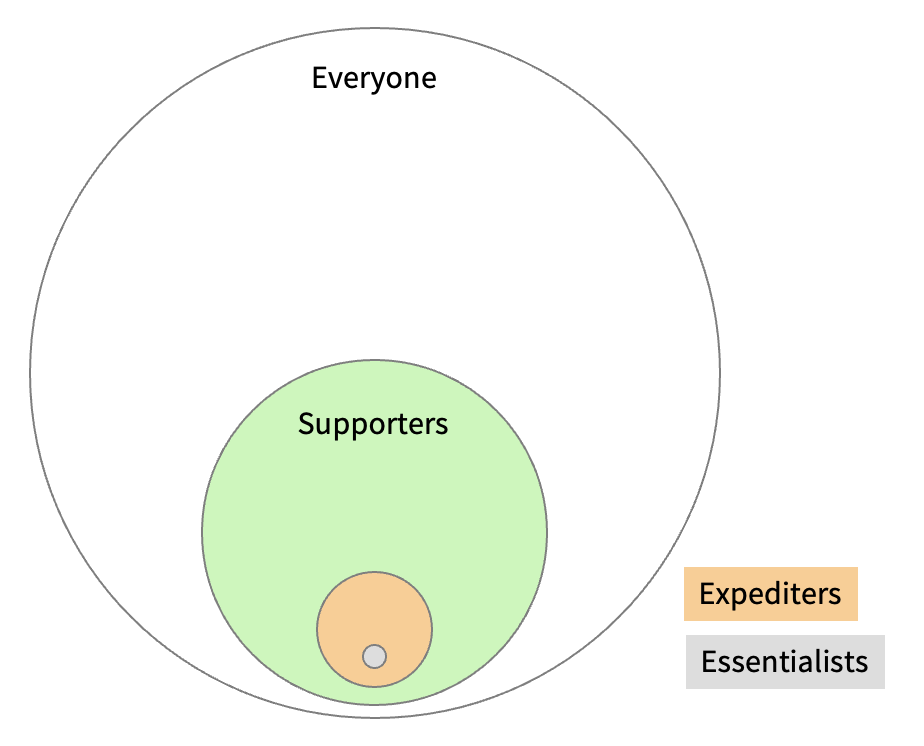
Equally critically, this plan does not require everyone’s participation — just enough of us.
How many is enough to change course? We can’t know for sure but (as I will explain later in the manifesto) the tipping point should be less than 23% of a population.
We can do this.
Making a start
So, a simple plan for changing course exists.
And now, unless this manifesto draws out a better plan or a better organisation to facilitate the plan5, we can make a start by establishing a facilitating organisation that can seek initial funding for collaboratively refining the plan.
Many individual philanthropists and philanthropic organisations (like Partners For A New Economy) already support initiatives to transform of our flawed economic system, but these helpful entities cannot support an organisation that doesn’t exist.
4. You can help to trigger the course change we all need
Interested in helping out right now? You can!
Find out how on the Play your part page.
You can support completion of the manifesto via this Givealittle page.
5. What you’ll find in the rest of the manifesto
The rest of the manifesto comprises five main web pages that each answer a key question.
Why haven’t we already changed course?
How can we unblock our ability to change course?
What mass actions will change our course?
What can you do to help trigger a course change?
How can we quickly grow widespread belief in our ability to change course?
(Each page’s publication status is listed at the top of this page.)
A storm of challenges
To help us to understand why we have not already changed course, the Challenges page explains:
- why the societal change we need requires focus first, then belief and numbers
- how we have been too busy to clearly see our own nature, systems, and plight
- how the global economic system disempowers us by keeping us busy, muddled, and divided
- why we can’t change course if we don’t empower ourselves as a global team
- why we can’t transform our economic system if we keep accommodating its flaws
A simplicity approach
To help us to break through our own busyness, and thus unlock the focus we need to change course, the Approach page explains how we can:
- seek simplicity and essentialism to overcome complexity and busyness
- consume clear, essential information to overcome the muddle of information overload
- team up to overcome the division of competitive individualism, making it the norm to solve societal problems communally and widely
- focus on ending harm-causing business to trigger a course change
- focus on developing wiser system goals to mature our course change
- efficiently collaborate on essential tasks to expedite our course change
A simple plan
To help us to efficiently change course as a focused, confident team, the Plan page sets out how enough of us (as Team Humanity) can:
- rally around a popular goal to change course
- bring about the course change through five mass actions
- enable and expedite success through essential collaborations and facilitations
- achieve urgency by setting essential deadlines
Play your part
Because changing course requires a facilitated team effort, the Play your part page outlines how you can help me to:
- identify a better plan or, if there isn’t one, support this plan
- identify an existing organisation to optimally facilitate the plan or, if there isn’t one, support the establishment of a new organisation
- develop collaborations and ideas for speedily mobilising Team Humanity
A multitude of voices
And, finally, because we can only change course when enough of us believe we can be successful, the supplementary Supporting voices page shows we can:
- grow widespread belief through a multitude of diverse voices (including inspiring personalities from sport, community, the arts and sciences, academia, business, and social media) advocating the Team Humanity Actions to their communities
- draw inspiration from momentum-building changemakers
- gain confidence from insightful words of wisdom (including quotations from the inspirational publications and films pictured below)


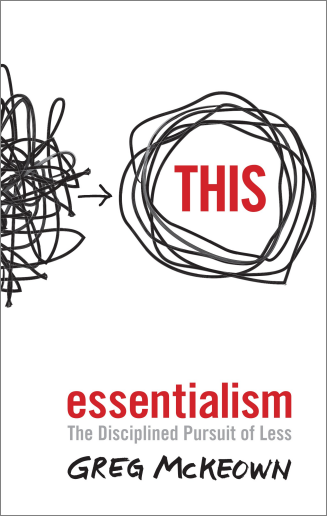
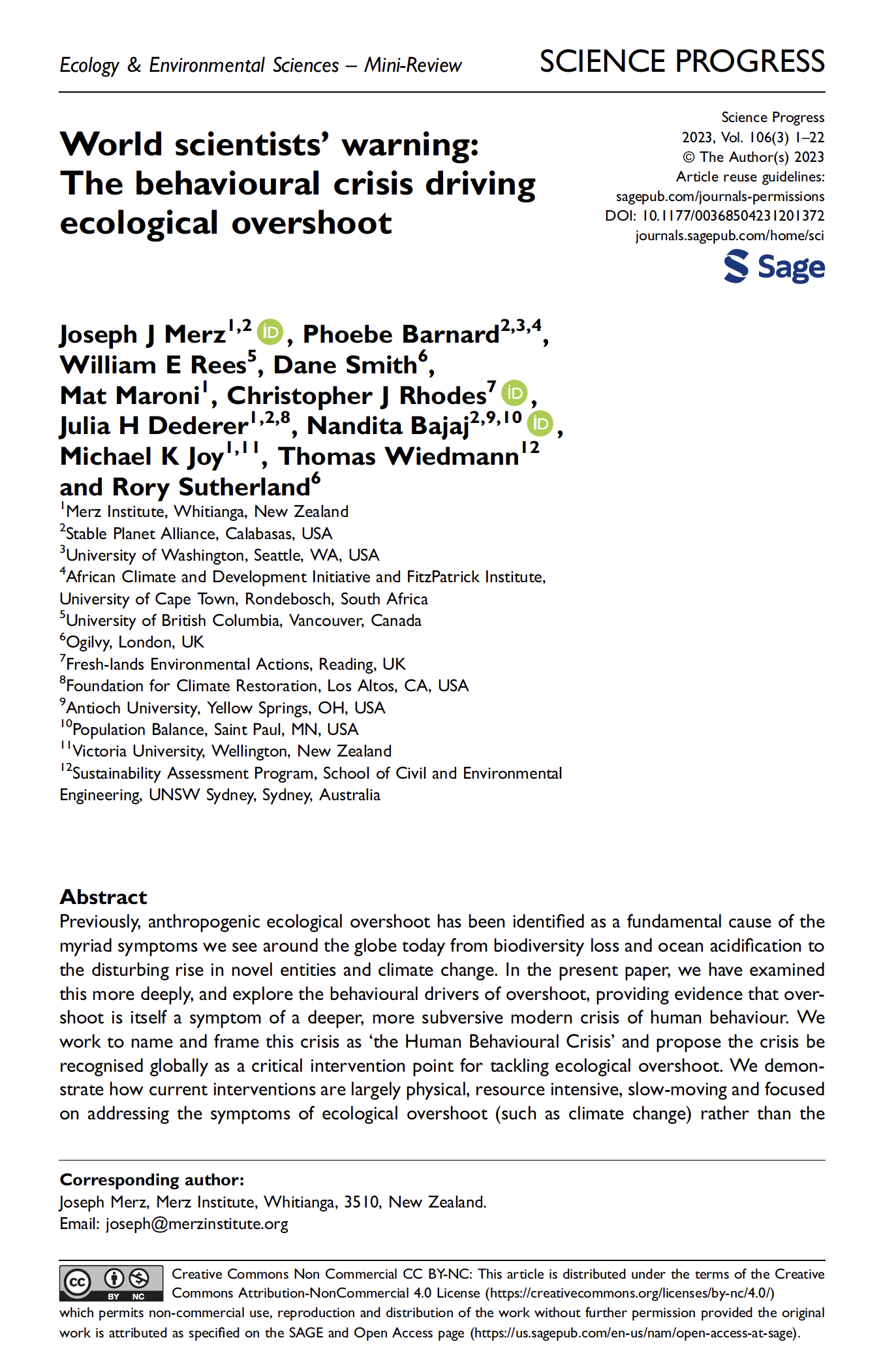
Helpful reports or papers (linked to official PDF downloads)



Notifications
If you would like to be notified as key information is added, please provide your name and email address by clicking the Notify me button (which takes you to a secure Typeform page).
To receive notifications via LinkedIn, please follow Same Page founder, Simon Hertnon.
Notes
By signing-up for notifications you are agreeing to our simple privacy policy.
This website is kindly being hosted by the fabulous team at Made for the World (UK).
Footnotes
- The table includes ‘inequality and injustice’ as a flaw to match the guiding principle of ‘equity and justice’. While EY’s report states that ‘inequity and injustice are foundational drivers of the polycrisis’, it does not include them as a flaw. The mismatch is not explained. ↩︎
- https://www.sbs.ox.ac.uk/climate-change-challenge/resources/margins-mainstream-how-sustainability-became-big-idea-business <Accessed December 2, 2025> ↩︎
- https://earth4all.life/global-survey-2024/ <Accessed December 2, 2025> ↩︎
- I envisage the CR Renew humanity’s wisdom and C5 Redesign betterment systems collaborations quickly convening indigenous leaders, policy advisers, researchers, sustainability experts, and others to efficiently synthesise existing knowledge, wisdom, and designs. ↩︎
- If you are aware of a plan that is more likely to trigger a course change to prevent ‘ecological collapse’ than the Plan outlined in this manifesto, then please, let me (and everyone else) know. ↩︎