
What mass actions will change our course?
To talk about the future is useful only if it leads to action now.
E F Schumacher, Small is Beautiful (1973)
In a nutshell, if humanity is to change course quickly enough to prevent ecological collapse, then enough of us need to:
- rally around a bold, system-level goal (‘a big ask’) that addresses the systemic flaws causing our plight
- achieve the goal by following a simple global plan that comes across as comprehensible, achievable, and inviting to the broadest of audiences
- collaborate like crazy to get jobs done
- identify and support an independent organisation to facilitate the plan
- set and meet essential deadlines
Plan sections:
- Rationale: We need ‘a big ask’, simple goals, and roles for everyone
- The five Supporter Actions
- The seven Expediter Collaborations
- The three Essentialist Facilitations
- The Plan deadlines and 10-year timeframe
Page status: This manifesto page is nearly complete. Once complete, it will continue to be updated as the work of the proposed foundation progresses.
What is the final piece of the puzzle?
- This manifesto’s Summary page (Summary) outlines our plight (impending ecological collapse) and our opportunity to address its cause by teaming up to reject, then redesign, the overall purpose, principles, and outcomes of the global economic system:
- from generating poorly-distributed financial wealth
- to generating ecological health and social health (and, thus, true prosperity) for us all
- The Challenges page will explain why our societies haven’t already made this change due, primarily, to our global culture of individual and societal busyness.
- The Approach page will show how a simplicity approach frees us from the debilitations of busyness.
Now we need a simple plan that anyone can understand, participate in, and promote.
Responses for the past 50 years have delivered public awareness, but not system change.
Whilst each valuable in some way, our myriad responses — policy design, political lobbying, small-group activism, innovations, countless organisations, conferences, studies, research papers, and so on — have been disjointed in their execution and incremental in their impact.
I am aware of no evidence or argument to suggest our civilisation can proactively change course (before ecological collapse) with only the same mix of responses.
Instead, an intervention of galvanising focus and simplicity seems essential.
By combining our individual and societal capabilities we can build a global social movement that has the power to change the underlying societal systems (starting with the flawed global economic system) that are keeping us on our path to ecological collapse.
We need mass action.
And before setting out this manifesto’s plan for mass action, here is the logic of its design. (Or you can jump straight to the plan’s five mass actions.)
1. Rationale: We need ‘a big ask’, simple goals, and roles for everyone
First, what hasn’t worked, and why?
Sustainability isn’t engaging enough of us
While global efforts to change course encompass many facets of society and fields of study, most fit under the umbrella term ‘sustainability’.
However, the logical broadness of sustainability’s three ‘pillars’ (environmental, social, economic) leads to the term meaning different things to different people and, consequently, persistent confusion, disinterest, and misuse.
Nearly 40 years ago, in 1987, the UN helpfully defined the term sustainable development to mean ‘meeting the needs of the present without compromising the ability of future generations to meet their own needs’1. However, humanity’s development remains unsustainable to this day.
How can such a sensible and vital directive be ignored by so many for so long?
Here are three reasons.
First, it took nearly three decades for the UN to add clarity and guidance for the global public through the launch (in 2016) of their Sustainable Development Goals — the ‘SDGs’.
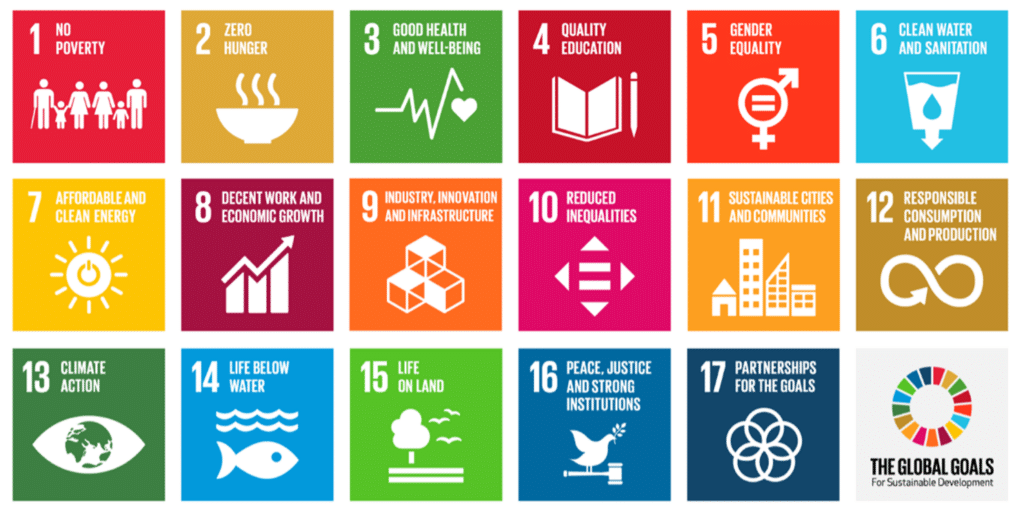
Second, the 17 goals are non-binding, and take-your-pick.
And third, in the middle of them, you’ll find the goal of ‘economic growth’.
Yes, the quality of this growth is loosely qualified by the other goals, but this goal (#8) explicitly accommodates the labelling of business activities as ‘sustainability initiatives’ when the corporation’s primary aim remains to increase its profit today regardless of the costs to everyone’s tomorrow.
This is a grave and fundamental flaw because seeking unqualified economic growth means seeking activities that are both helpful and harmful to what matters most: ecological health and social health.
For example, society achieves ‘economic growth’ (and, thus, financial wealth) from responses to harm-causing business, such as: recycling responses to needless packaging; clean-up responses to microplastic pollution and oil spills; and mental health responses to suffering (depression, loneliness, paranoia) caused by tech-manufactured social media addiction.
Meanwhile, society can enhance ecological health and social health by reducing select economic activity (less waste, less pollution, less land development, less use of finite resources, less noise, less clutter, fewer distractions, less busyness, and so on), but our global economic religion sidelines this truth. Sufficiency is our demon; profiteering, our saint.
Of course, living in a manner that is ‘capable of being sustained’ remains an essential individual and collective pursuit, and learning how to live sustainably remains an essential societal need.
But the truth also remains that collectively pursuing sustainability has not engaged a popular audience in today’s busy, individualised world, and is unlikely to do so.
The concept of sustainability just isn’t clear enough, solid enough, or measurable enough to garner a popular following.
We can learn from pursuits that easily engage global masses
Asking yourself Who finds mass engagement easy? quickly illuminates the brightest of engagement bright spots: football (soccer).
We are not wired to rally around complex goals like addressing climate change, inequality, biodiversity loss, geopolitical instability, and other crises — let alone all of them at once.
Instead, we are wired to follow simple participatory pursuits that we can see, understand, measure, and discuss. Pursuits like supporting a professional football club.
The British football club Manchester United is widely acknowledged as having the largest fan base of any sports team, with its own investor relations web site stating: ‘Manchester United is the No.1 Club in the No.1 sport’ with ‘1.1 billion fans and followers worldwide’2.

Photo credit: Saturday Star, South Africa
This level of engagement is worthy of any change agent’s attention and analysis, but while Manchester United is a standout, vast legions of football supporters are common almost everywhere on Earth.
So, what are the key ingredients for football’s extraordinarily broad appeal?
- The pursuit is simple — the game has minimal rules and transparent outcomes: win, lose, or draw.
- There are no systemic barriers to involvement — playing or supporting the game is not dependent on education, language, culture, religion, or social status.
- There are roles for everyone — while there are limited roles in playing, coaching, and management groups, anyone can play a role as a supporter.
- Those involved are typically recognisable — through team uniforms and supporter gear.
Now, let’s look at the same ingredients in relation to supporting a movement based on sustainability, or one based specifically on achieving economic transformation, or one seeking to address climate change, or inequality, or biodiversity loss, or geopolitical instability, and so on.
- None of these pursuits are simple — the problems, the fixes, the options, and the outcomes are all complex.
- None seem universally accessible — in my experience, most participants have a tertiary education, or the desire and ability to volunteer, or both.
- None have roles for everyone — and, moreover, most of us don’t know how to actively support these causes in a way that we find meaningful and inspiring.
- Those involved are often unrecognisable — while supporters of activist organisations (like Greenpeace) are typically recognisable, especially at marches and protests, at the wider movement level (say, addressing biodiversity loss) there is no uniting logo, colour, uniform, or supporter gear.
Each of these gaps represents an opportunity.
- We can choose a simple overarching goal.
- We can provide a role for everyone.
- We can provide supporter gear.
We can choose a simple overarching goal
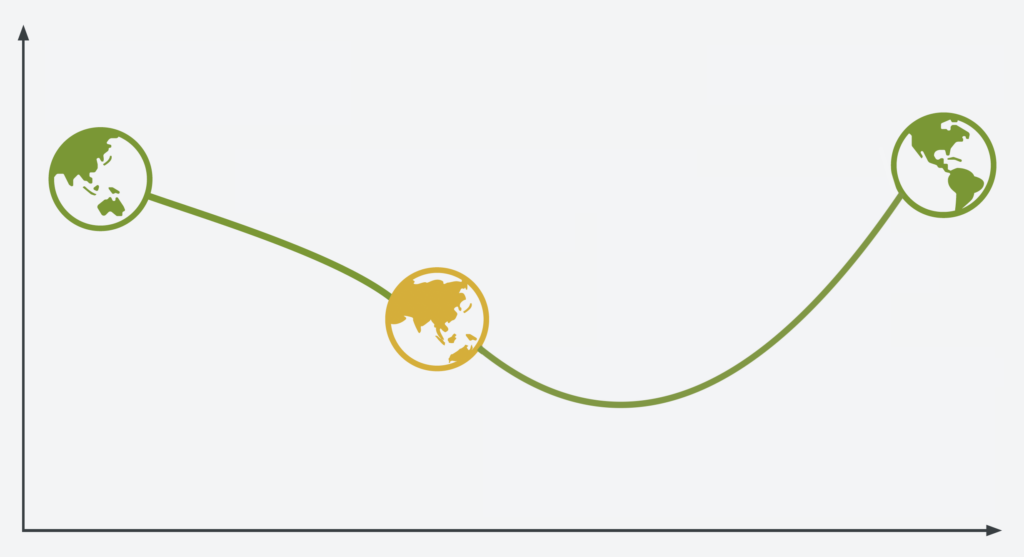
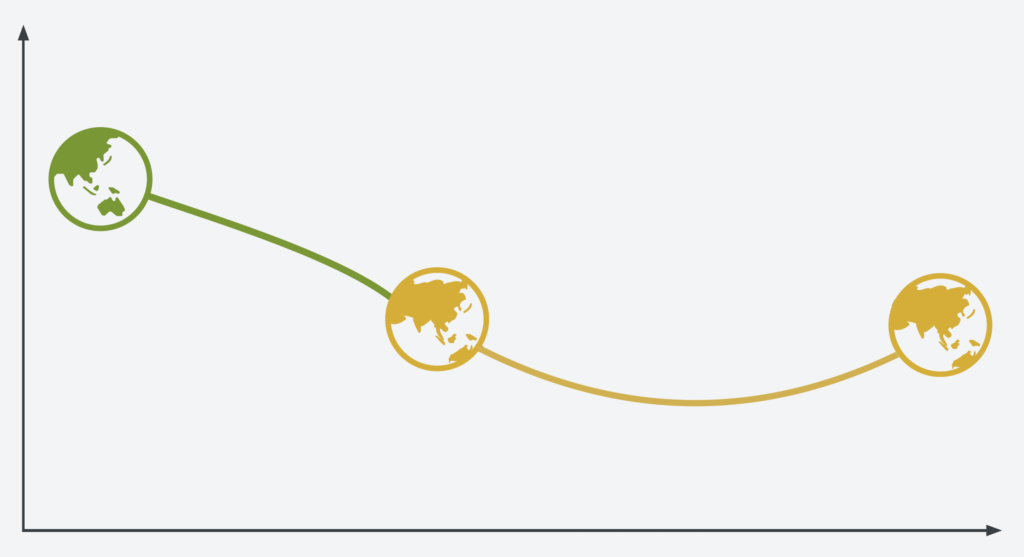
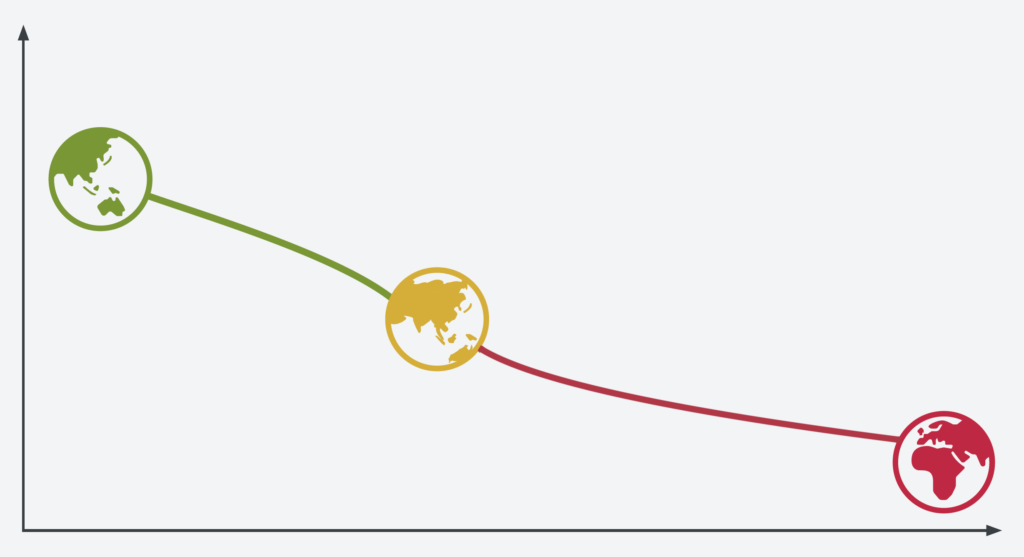
The concept of changing course to avert disaster is clear, memorable, and universally familiar. This is why this manifesto highlights the Planetary Solvency graphic originally created by Sandy Trust.
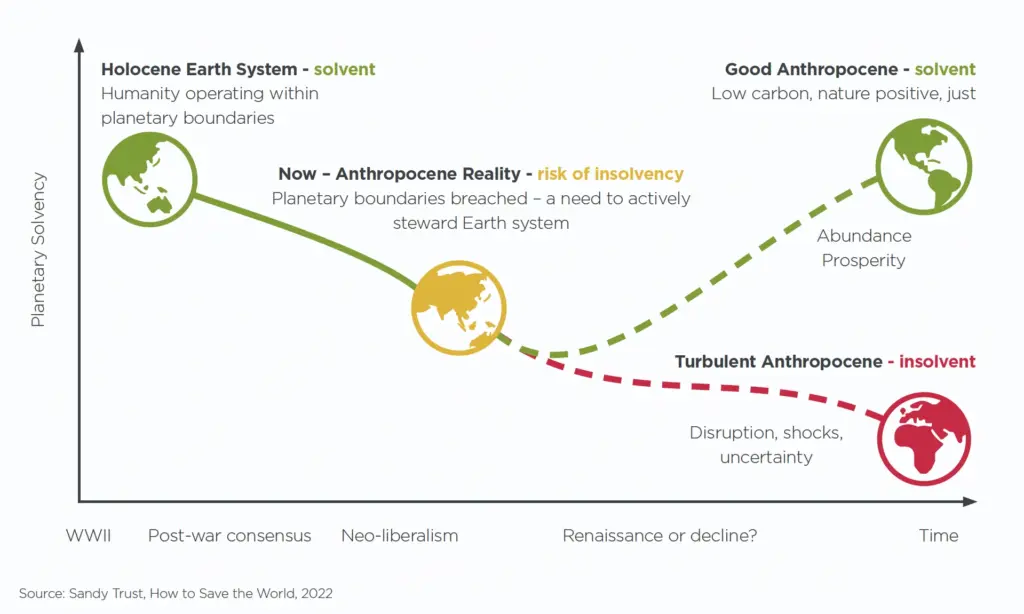
The Anthropocene Reality and Planetary Solvency from Planetary Solvency — finding our balance with nature, a report by the Institute and Faculty of Actuaries and the University of Exeter (January 16, 2025)
The overarching goal presented by the graphic is not for humanity to live sustainably (a complex concept), it is for humanity to change from one course to another (a simple concept).
The graphic only hints at how we might achieve this goal (‘Low carbon, nature positive, just’). It leaves room for its audience to team up and work out the rest — to do whatever is needed to change course.
To enable comprehensibility and memorability, the graphic contains only 52 words (none of which is ‘sustainability’).
Cleverly, though, none of the words are really necessary to communicate the graphic’s primary message: that we face a binary choice.
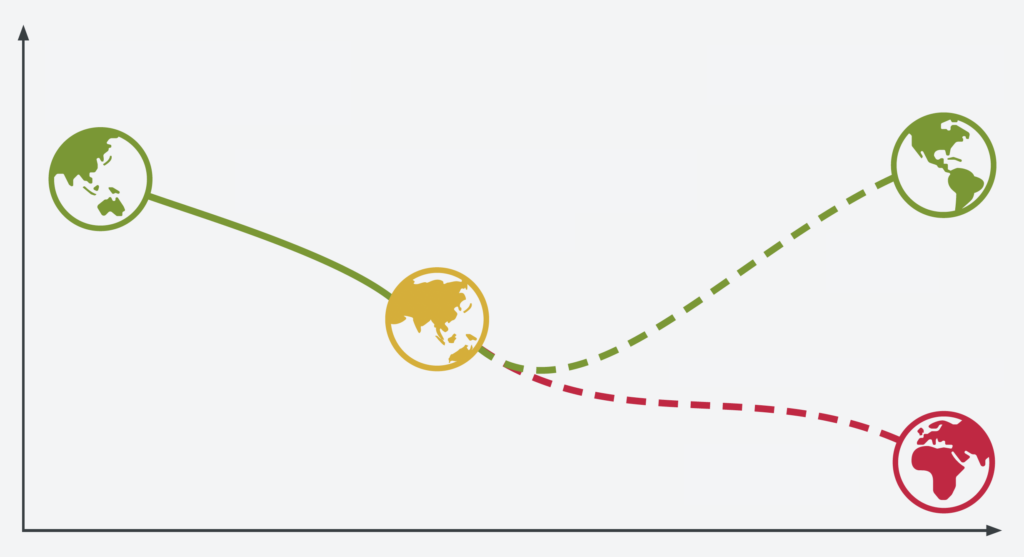
And messages about binary choices (like win or lose, live or die, succeed or fail) are innately memorable and implicitly participatory.
Which path do you wish to take?
The graphic’s comprehensibility is also enhanced through the use of colour-coordinated imagery (primarily ‘go’ green and ‘stop’ red).3
Will human civilisation flourish into the future, or come an end?
The solid and dashed lines also help to communicate choice by conveying the past (the solid line) and the potential futures (the two dashed lines) along a time continuum.
Which path will we take?
To appeal to their audience of actuaries, the Planetary Solvency authors added to Sandy Trust’s original graphic the colour-coordinated words solvent (as the label for their preferred option) and insolvent (for the bad option). While a civilisation fast becoming unable to pay its ecological debts is certainly a powerful metaphor, for a general audience these terms could be reframed as optimisation vs exhaustion, flourishment vs collapse, or some other set.
Interestingly, EY’s A new economy report also:
– presented readers with a binary choice (‘a new economy’ or ‘a polycrisis economy’)
– used green and red to represent the two options
– promoted their preferred option as the main title of their report
The setting-up of binary choices to engage large audiences is something politicians do all the time. Here, without judgment, is a successful example.
| ‘Good’ option | Make America Great Again (red). |
| ‘Bad’ option | Let the country go to ruin by out-of-touch people who don’t care about you (blue). |
| Proposition | Support the good option by voting red, not blue. |
The complexity of ‘sustainability’ makes it an uninviting alternative to our all-powerful consumerist status quo.
EY has helpfully tuned the proposition by asking its audience to choose ‘a new economy’ (green) over a ‘polycrisis economy’ (red). But, as proponents of every kind of economic model (Beyond GDP, Care, Circular, Degrowth, Doughnut, Green, Indigenous, Regenerative, Rights-Based, Steady State, Wellbeing, etc) encounter, the masses are still left with two paralysing, off-putting questions.
- What is this thing we call ‘the economy’?
- If there really is a (practical) better one, why can’t smart people agree on what it is?
These unanswered questions have plagued the sustainability sector since I became involved 20 years ago. Changing our economic system has never felt like an empowering binary choice. Instead, it feels like an incremental impossibility.
So, to seed a popular movement, the goal we rally around must be presented as a universally comprehensible binary choice that rises above the detail of complex interrelated crises and settles on the indicator that matters more than any other: Are we on the right path?
Accordingly, this manifesto proposes an overarching goal of choosing to change course from the wrong path to the right path.
| ‘Good’ option | Change course to a path towards ecological and social wellbeing (green). |
| ‘Bad’ option | Continue on our path towards ecological collapse (red). |
| Proposition | Support the good option by first teaming up. Then perform three more actions (notify, reject, prohibit) to turn away from collapse. Then perform one last action (redirect) to turn towards ongoing wellbeing. |
We can make something like this work.
The option colours don’t need to be green and red, we can choose other colours.
The proposition can be staged to focus on performing one action at a time (akin to scoring one goal at a time in a football match as a simple measure of progress towards victory).
And perhaps the collaborations I propose below will uncover an even simpler, more compelling binary choice for rescuing our future than maintaining or changing our course.
But whatever overarching goal we adopt, logic tells me that a simple one like choosing one of two paths will provide a much better chance of engagement and, thus, success, than the current mix of complex propositions consuming our finite energy and attention.
Simplicity will unlock greater focus, belief, engagement, and power.
If helpful, we can even borrow from the familiarity of football’s win-lose-or-draw structure. Achieving all five Supporter Actions is a win, achieving the first four is a draw (collapse is averted, but risk remains), and achieving anything less is a loss.
And, finally, to help us to frame and visualise a win, we can introduce and promote terms and images that represent our desired future realised.
For example, a term might be ‘public luxury’.
While there is not enough space or resources on Earth for everyone to enjoy private luxury, there is enough to provide everyone with magnificent public parks, gardens, libraries, tennis courts, transport systems, playgrounds and community centres. We should each have our own small domains — we should enjoy private sufficiency — but when we want to spread our wings, we can, through public luxury, do so without seizing resources from other people.
Monbiot and Hutchison, The Invisible Doctrine (2024)
And an image might be like this one from Germany’s wonderful Reinventing Society, who commission ‘future graphics’ to ‘awaken a desire for change’. This one is of how Frankfurt might look in 2045 if we get on with the work of designing and manifesting ‘a vibrant and regenerative society’.

Image credit: Frankfurt Realutopie 2045 by Reinventing Society / Render Vision,
CC BY-NC-SA 4.0
We can provide a role for everyone
Crucially, this plan provides a role for everyone.
| Role | Sports team analogy |
|---|---|
| Supporters perform the five mass actions to prevent ecological collapse. | As with the fans of today’s global sports, this movement’s supporters can be anyone from anywhere. Our voices, wallets, and votes give us all the power we need to change course. |
| Expediters contribute to one or more of the seven expediting collaborations to help Supporters perform the mass actions quickly enough to prevent ecological collapse. | Expediters are also Supporters, but we can think of them as players on the pitch. They are the millions of practitioners and volunteers dedicated to delivering ecological and social betterment. |
| Essentialists perform the three essential facilitations to simplify and empower the work of the Expediters and Supporters. | Essentialists are also Expediters and Supporters, but we can think of them as a coaching team who provide game plans and resources to help players and supporters make their best contributions. |
Equally crucially, this plan does not require everyone’s participation — just enough of us. Enough Supporters. Enough Expediters. Enough Essentialists.

How many is enough to change course? No one can know for sure, but a critical mass will be less than a quarter of any democratic population.
This is because societal change ultimately requires political support (because it is elected representatives, or ‘lawmakers’, who can change the goals, standards, and rules of our societal systems) and gaining 50% of votes — when you account for ineligible voters (like children) and those who fail to vote — requires about 23% of a population.
However, the tipping point for such change may be a whole lot less.
Professor Erica Chenoweth from the Harvard Kennedy School has researched civil resistance and formulated ‘the so-called “3.5% rule” — the notion that no government can withstand a challenge of 3.5% of its population without either accommodating the movement or (in extreme cases) disintegrating.’4
As the BBC reported in 2019, Chenoweth ‘has shown it takes around 3.5% of the population actively participating in the protests to ensure serious political change.’
And while there are already pockets of consumer boycotting that curtail businesses many of us know cause social or ecological harm, global society has not scratched the surface of what coordinated mass boycotts could achieve.
It is, I strongly believe, long overdue for us to team up and discover precisely how many of us are needed to make harm-causing business (not necessarily whole businesses) unviable.
We can provide supporter gear
Sure, we’re going to have to put our heads together to select a movement name and identity that billions of us will choose to show our support for.
And, sure, we’re going to have to collaborate and innovate to ensure our supporter gear is not harm-causing, like most of today’s polyester-based supporter gear.
But we have the ability to do these things.
2. The five Supporter Actions
Based on the rationale above, a plan capable of supporting a social movement must achieve three key change tasks, which translate to enough of us performing just five mass actions.
| Three key change tasks | Achieved by five mass actions |
|---|---|
| Empower our response | Team up (A1) |
| Reject our flawed status quo | Notify businesses and politicians (A2) that we will boycott harm-causing business, then vote for its prohibition Boycott harm-causing business (A3) Prohibit harm-causing business (A4) |
| Design our future state | Redirect societal systems (A5) so they all serve and prioritise ecological health and social health |
Empower, reject, design. Three tasks any of us can perform through the five mass actions we can term Supporter Actions, given they will be performed by supporters of a course change (the ‘Supporters’).
| Action | Need |
|---|---|
| A1 Team up | First, we equip our movement with the power of numbers. |
| A2 Notify businesses and politicians | Second, using our millions-strong vocal power, we invite all businesses and politicians to join us in boycotting and prohibiting harm-causing business. |
| A3 Boycott harm-causing business | Third, using our millions-strong consumer power, we stop supporting businesses that fail to show us their activities are wholly healthy or harmless. |
| A4 Prohibit harm-causing business | Fourth (and simultaneously), using our millions-strong electoral power, we withhold support for candidates who fail to assure us they will prohibit harm-causing business. |
| A5 Redirect societal systems | Fifth (and simultaneously), using our millions-strong wisdom and design capabilities, we amend the goals, rules, and structures of all our societal systems so they serve and prioritise ecological health and social health. |
For each action, I will now answer these six questions.
- What opportunity does the action address?
- What is the action’s key purpose?
- What is a simple method for accomplishing the action?
- What is a practical timeframe for accomplishing the action?
- What is the action’s expediting collaboration?
- What are the action’s key milestones?
First action
Team up to empower changing course (A1)
| A1 Team up |
| Opportunity Given sustainability’s shift ‘from margins to mainstream’5, right now enough of us could team up (as ‘Team Humanity’, for example) to gain the crucial social change powers of numbers and cohesion. By starting with a large group of course-change Supporters, we will exponentially empower each subsequent mass action. Key purpose To empower changing course through mass participation. Simple method 1. Led by Expediters from the Mobilise Team Humanity collaboration (C1), we first design a global campaign and build an online portal to match (enabling the verified participation of Supporters from any country or territory through appropriate online technology). 2. We launch our campaign to convene a global community of enough course-change Supporters to change societal systems. 3. We attract Supporters in a similar fashion to (and at the same scale of) the world’s most popular sports teams (like Manchester United Football Club) by having coherent goals and highly-recognisable supporters’ gear. 4. Through the Mobilise Team Humanity collaboration (C1), Expediters from comparable global organisations (like the 69-million-member AVAAZ web movement, the 5-million-member World Wide Fund for Nature (WWF), and the steadily growing Wellbeing Economy Alliance), efficiently seed our community with mass associate ‘memberships’. 5. We continually promote the community by publicising the participation of high-profile Supporters (like musicians, actors, and elite athletes), and by assisting them to advocate for their millions of fans and followers to also ‘team up’. Practical timeframe Start in 2026, and continue for as long as there is a need for global social reform. This consumer and electoral bloc of ‘active citizens’ could also seed the overdue establishment of a world federation, and evolve into a global citizen’s assembly. Expediting collaboration See how Expediters can collaborate to efficiently Mobilise Team Humanity (C1). Key milestones > A draft Join Team Humanity (or similar) global supporter campaign. > First 100,000 ‘team members’, first 1 million, and so on. > Enough Supporters in a jurisdiction to confidently empower the remaining four mass actions (around 20–25% of the population). |
Second action
Notify businesses and politicians to start changing course (A2)
| A2 Notify businesses and politicians |
| Opportunity Focussing on the world’s wealthiest democracies, our team could exercise its millions-strong vocal power to give notice to every business and political candidate that our custom and votes will only go to those whose actions support our collective rejection of harm-causing business, and to compellingly invite them to proactively support the movement. Key purpose To start changing course by concertedly inviting all businesses and politicians to proactively participate in the movement. Simple method 1. We widely publicise our team’s cohesive determination* to end support for harm-causing business 2. We make clear to businesses and politicians what actions they can take to support and become part of our popular movement. Practical timeframe TBC Expediting collaboration See how Expediters can collaborate to efficiently Support societal participation (C2). Key milestones TBC |
* Backed by global surveys like the Earth for All Survey 2024 and the Global Commons Survey 2024 (both conducted by IPSOS) that show majority support in wealthy democracies for transforming the purpose of the global economic system.
Third action
Boycott harm-causing business to strengthen changing course (A3)
| A3 Boycott harm-causing business |
| Opportunity Next, our team could exercise its millions-strong consumer power to: – multiply support for helpful business that enhances ecological health and social health – continue support for harmless business – end support for harm-causing business (freeing-up more support and custom for helpful and harmless business) Key purpose To strengthen changing course without needing to wait for ‘the system’ to change (eg, for harm-causing business to be prohibited). Simple method Through a global consumer boycott movement, building on the momentum of existing international consumer boycotts (like QuitGPT), and informed and powered by a simple prove-you’re-worthy-of-our-custom consumer awareness program. In short, we collectively remove our social licence for businesses (or specific products or services they sell) that are unable to explain to us, simply and transparently, that their business activities are not causing systemic (ecological, social, or inter-generational) harm. Practical timeframe TBC Expediting collaboration See how Expediters can collaborate to efficiently Reinvigorate social permissions (C3). Key milestones TBC |
Fourth action
Prohibit harm-causing business to solidify changing course (A4)
| A4 Prohibit harm-causing business |
| Opportunity During the 2026–2030 global cycle of democratic elections, our team could also exercise its millions-strong electoral power to support only candidates who commit to prohibiting harm-causing business. Key purpose To solidify the course change through the simplest possible legal prohibition of harm-causing business activity. Simple method 1. Through the Notify businesses and politicians (A2) action, our team will have already notified all political candidates that, regardless of their political affiliation, if they want our bloc’s votes they must promise to prohibit harm-causing business. 2. Through the Simplify legal protections (C4) collaboration, Expediters from legal firms around the world will have already produced the wording and process for the simplest possible legal amendment for Supporters to provide to every political candidate. (This could be as simple as a single legal clause, tailored by jurisdiction as necessary, that prohibits ‘any activity that results in systemic ecological, social, or intergenerational harm’, or similar, to be added to the director’s responsibilities of the jurisdiction’s corporate law.) 3. Supporters only vote for candidates who promise to enact the law change. Practical timeframe During the 2026–2030 global cycle of democratic elections. Expediting collaboration See how Expediters can collaborate to efficiently Simplify legal protections (C4). Key milestones > Widespread engagement in the drafting process. > Appointment of a coordinating legal firm. > Participation of at least one legal firm in every democratic jurisdiction. > Finalised (and translated) amendments for all democratic jurisdictions. > Finalised (and translated) amendments for all remaining jurisdictions. > Enactment of the amendment in all democratic jurisdictions. |
Fifth action
Redirect societal systems to mature changing course (A5)
We are born to cooperate [and thus] we are innately equipped to participate in the grand human project, which is to create and maintain social harmony — and harmony between us and the vast ecosystem of which we are a part…
Hugh Mackay, The Way We Were (2024)
| A5 Redirect societal systems |
| Opportunity By 2035, our team could complete an essential redesign of our intertwined, globally-linked societal systems (trade, justice, health, education, etc) to end their habitual subservience to the critically-flawed economic system. Coordinated system transformations will redirect each system’s goal so that, as a set, they harmoniously and sustainably achieve the overarching purpose of delivering optimal social and ecological wellbeing within the constraints of Earth’s systems (land, air, water, life) and resources. Key purpose To complete changing course by intentionally revising the goals and rules of our contorted societal systems which, today, all serve the collapse-inducing pursuit of economic growth. Simple method Design and convene a global citizen-led program of system-redesign collaborations that are inspiringly transparent, participatory, respectful, joined-up, and efficient. Practical timeframe TBC Expediting collaboration See how Expediters can collaborate to efficiently Streamline system transformation (C5). Key milestones TBC |
Combined, these five actions will empower (A1), start (A2), strengthen (A3), solidify (A4), and complete (A5) the course change.
3. The seven Expediter Collaborations
…while there is certainly hope [of economic transformation], translating that hope into widespread action requires intentional, collaborative effort.
EY, A new economy (2024)
Why do we need Expediter Collaborations?
While the first four Supporter Actions (team up and reject harm-causing business) will enable us to veer away from ecological collapse, and the fifth Action (redirecting all our societal systems to prioritise the growth of social and ecological wealth over financial wealth) will enable us to plot a course toward a flourishing, regenerative future, there is a time limit: speed matters.
With six of Earth’s nine planetary boundaries already passed, we are fast approaching tipping points that each lock-in the failure of an ‘Earth system process’ (eg, a key ice sheet melting), that then trigger other process failures (eg, ocean currents stalling), which combine to cause overall ecological collapse6.
Thus, collaborations are critical for giving us the best chance of achieving the Actions before our trajectory towards ecological collapse becomes irreversible.
| Collaboration | Purpose |
|---|---|
| C1 Mobilise Team Humanity | To expedite teaming up (A1) |
| C2 Support societal participation | To expedite notifying businesses and politicians (A2) |
| C3 Reinvigorate social permissions | To expedite boycotting harm-causing business (A3) |
| C4 Simplify legal protections | To expedite prohibiting harm-causing business (A4) |
| C5 Streamline system transformation | To expedite redirecting societal systems (A5) |
| CR Renew humanity’s wisdom | To inform all five mass actions |
| CP Promote helpful information | To support all five mass actions |
As one streamlined global program supported by the Coordinate the Collaborations facilitation (FC), this initiative will enable efficient, synergetic collaboration between thousands of similarly-motivated entities.
In school we’re taught to compete and are rewarded accordingly, yet our great social and environmental predicaments demand the opposite — the skill we most urgently need to learn is cooperation.
George Monbiot and Peter Hutchison, The Invisible Doctrine (2024)
And while anyone can contribute to these collaborations, Expediters are likely to be those already skilfully working towards environmental and social betterment, such as:
- Experts in fields like systems, ecology, climate, indigenous knowledge, sustainability, regeneration, economics, politics, governance, and so on
- Networkers (such as community leaders, politicians, stars of sports and the arts, LinkedIn voices, and other ‘influencers’)
- Futurists
- Philanthropists
- Community groups
- Non-governmental organisations (NGOs)
- Leaders, groups, and organisations dedicated to sustainable and regenerative business
First collaboration
Mobilise Team Humanity to expedite teaming up (C1)
This sub-section will be uploaded soon.
Second collaboration
Support societal participation to expedite notifying businesses and politicians (C2)
This sub-section will be uploaded soon.
Third collaboration
Reinvigorate social permissions to expedite boycotting harm-causing business (C3)
Every business requires the permission of society to operate. They need our custom, and they also need us to support the law or laws that permit their business activity.
Collectively, we can put bad business out of business, but only if we exercise what’s termed our ‘social licence to operate’ (SLO). This is why the third collaboration is to reinvigorate social permissions.
| C3 Reinvigorate social permissions |
| Key purpose To efficiently expedite the achievement of the A3 Boycott harm-causing business action. Rationale Currently, most of us give our social licence away. We are aware that some products, services, business practices, or businesses themselves are harm-causing, but we don’t think we can do anything about it. As individuals, none of us can put a bad business out of business (thus leaving more custom for good business) but, as a huge team, we can. Simple expediting mechanisms Thus, this collaboration could concertedly: – support, connect, and build on existing consumer boycotts, both nationally and internationally – support consumers to wisely exercise their SLO through a simple and transparent global consumer awareness program* – support businesses to redesign or retire harm-causing products, services, and practices through a global business transformation program This collaboration could also utilise a global social licence advocacy platform created as a cross-collaboration output to expedite all five Supporter Actions. Obvious Expediter opportunities Organisations like the UK’s Better Business Network and Future-Fit Business, New Zealand’s Sustainable Business Network, and the global Fairtrade International and B-Corp (B Lab) movements — among many others — could all play leading roles in this collaboration. |
* I have a blueprint for a simple and transparent global awareness program that I can contribute to this collaboration.
Fourth collaboration
Simplify legal protections to expedite prohibiting harm-causing business (C4)
In democratic populations, our social permissions extend to the rules of society, expressed in laws, which are created or amended by the politicians (or ‘lawmakers’) we licence through our votes.
The simpler it is to amend the laws governing business activity, the faster we can prohibit harm-causing business. This is why the fourth collaboration is to simplify legal protections.
| C4 Simplify legal protections |
| Purpose To efficiently expedite the achievement of the A4 Prohibit harm-causing business action. Rationale Globally, corporate laws allow business activity that directly or indirectly causes harm to life-sustaining ecological and social systems. To end this accommodation, these laws must change, but not through added detail and complexity. Complexity within and across legislation makes compliance difficult to achieve and police, and advantages entities that can afford costly legal counsel. Thus, to strengthen our legal protections, we need to simplify base corporate laws (such as the Companies Act in New Zealand, the UK, and India, or the Corporations Act in Australia) so the burden of proof rests on businesses to prove they are not causing systemic harm, rather than requiring society to prove they are. Such amendments would be a strengthening and blanket application of the precautionary principle that is today only broadly applied to the pharmaceutical, food production, and chemical manufacturing industries. Simple expediting mechanisms Prohibiting harm-causing business could be as simple as adding one legal clause (eg, one that prohibits ‘any activity that results in systemic ecological, social, or intergenerational harm’) to the director’s responsibilities within every jurisdiction’s corporate law. Thus, this collaboration could concertedly: – convene a group of legal experts to design simple (eg, one-sentence) no-systemic-harm amendments for every jurisdiction* – develop and socialise amendment designs – support politicians (‘lawmakers’) to enact the amendments – educate voters about the amendments – support resulting system changes This collaboration could also utilise a global social licence advocacy platform created as a cross-collaboration output to expedite all five Supporter Actions. Obvious Expediter opportunities A global environmental law charity like the UK-headquartered Client Earth could lead this collaboration. |
* Such amendments (or new laws) will sit upstream of all current harm-prevention laws and regulations, thus efficiently making many downstream laws stronger or, better still, redundant.
Fifth collaboration
Streamline system transformation to expedite redirecting societal systems (C5)
This sub-section will be uploaded soon.
Sixth collaboration
Renew humanity’s wisdom to inform all five mass actions (CR)
This sub-section will be uploaded soon.
Seventh collaboration
Promote helpful information to support all five mass actions (CP)
Our self-caused plight proves that our societies lack the knowledge we need to live well in the present without compromising our descendants’ ability to live well in the future.
And, yet, most of us are drowning in information.
This is partly because our societies do not adequately distinguish information from knowledge.
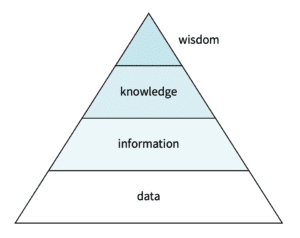
Information, which is compiled from data, can be used to teach us knowledge.
But overwhelming quantities of information can also obscure or bury knowledge.
Clearly, our ancestors possessed enough knowledge for their survival and our existence, but few possessed much (if any) written information.
Through traditions, oral teachings, and experience, they knew what they needed to know.
Today, our digitally-empowered societies create more information in a day than any pre-electric society would have created in a year. As with every other industry, we have followed the trap of unnecessary exponential growth despite our finite needs and capacities.
Ironically, even our information-spewing, unhelpfully mis-named* invention, AI, acknowledges the impacts of endless overproduction.
✦ AI Overview
The phrase “you can never have too much information” is a debatable idea that suggests gathering as much data as possible, but it overlooks the human brain’s limited capacity for processing and the negative effects of information overload.
* Sure, we have invented augmented human intelligence (AHI), but there is no such thing as artificial intelligence (AI).
Our blind pursuit of more (‘unsustainable growth’) rather than enough (‘sufficiency’) infects everything we do.
The essential information humanity needs to survive and thrive sustainably already exists, but it’s lost in the flood.
Within today’s digital age, most of us have forgotten how to efficiently water the knowledge gardens that are our extra-super-computing minds. Instead, we leave the tap on all day and into the night. Our minds are flooded with images and words — most of them attention-grabbing ‘sound bites’ — but the precious knowledge we need to live well barely grows.
Information is not all equal. You can have too much There is clear and unclear information. And there is helpful and unhelpful information.
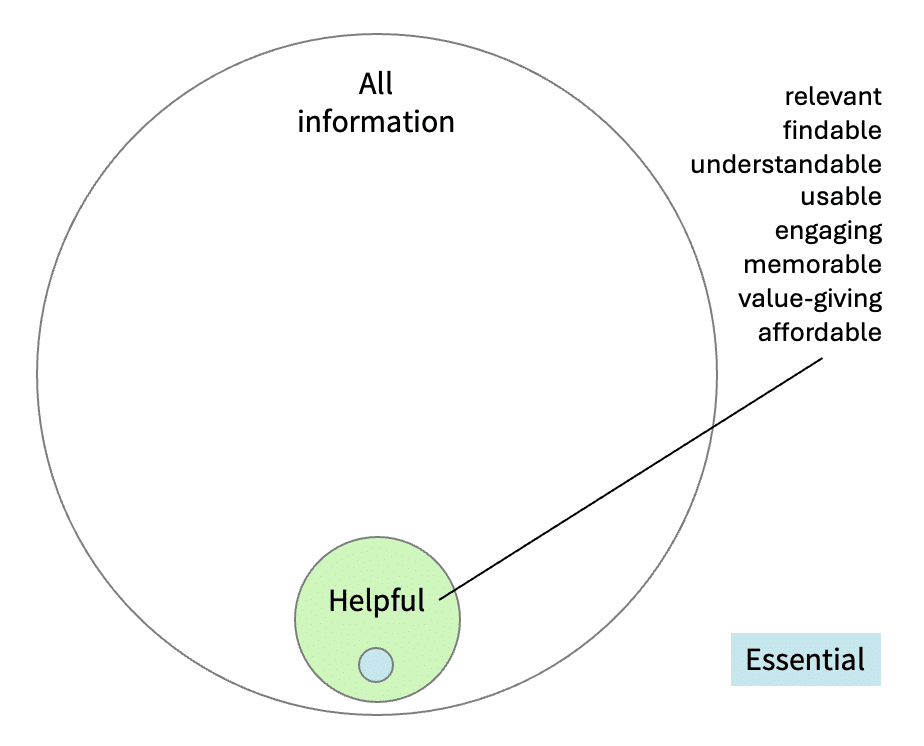
To live well today and into the future, we don’t need ever-more information; we just need enough helpful information.
Helpful information is a concept and framework I am developing to support this initiative, and to address the general problem of information overproduction.
To be clear, helpful information goes beyond ‘plain language’ which, for example, New Zealand’s current Plain Language Act 2022 defines as language that is ‘clear, concise, and well organised’ for an ‘intended audience’, and the 2023 ISO Plain Language Standard (ISO 24495-1) defines as being relevant, findable, understandable, and usable.
Although I have worked for years as a plain language professional, and greatly value its strengths, I have also been acutely aware that promoting plain language does not directly address the greater issue of information overproduction.
If every unclear document that exists were rewritten in plain language, we would still be drowning in more information than we can consume. We would still be suffering from essential knowledge blind spots because our finite attention has been spent consuming non-essential (or untrue) information. We would still be left to assume that modern life is an individual competition to out-consume other humans.
So, we need less and better information that not only possesses the plain language qualities outlined above, but is also explicitly value-giving. It needs to fill our knowledge gaps of how to live well, not further overwhelm our flooded, over-stimulated minds. It needs to be accurate so we can trust it, engaging so we consume it, and memorable so we don’t forget it. And, finally, we also need our information to be produced responsibly, affordably, and efficiently.
This is the kind of information Expediters will need to produce when they invite and enable Supporters to complete the five mass actions. Helpful information, not more information.
And this is why the seventh collaboration is to promote helpful information.
4. The three Essentialist Facilitations
Next, how do we enable both the Supporter Actions and Expediter Collaborations?
This is where the Essentialist Facilitations fit in.
To facilitate is to make something ‘possible or easy’ and, by my reckoning, a global movement to change course requires at least three facilitations.
| Facilitation | Purpose and method |
|---|---|
| FS Simplify the overall task | To seed popular focus and generate enough belief that changing course is achievable by supplying a simple action plan. |
| FP Provide essential information | To support and stimulate mass participation in the movement by providing essential information to every community in the world. |
| FC Coordinate the Collaborations | To speed up achieving the Supporter Actions by providing streamlining services to the Expediter Collaborations. |
These three facilitations are essential in the sense of being critical to success, and also in the sense of their outputs being necessarily stripped-back (because non-essential tasks and information will only put off Supporters and sidetrack Expediters).
First facilitation
Simplify the overall task to create focus and belief (FS)
Because Supporters and Expediters cannot rally around complex or impractical pursuits, the first facilitation is to simplify the overall task.
| FS Simplify the overall task |
| Key purpose To seed popular focus and generate a tipping point of belief — particularly among those already working towards sustainability, regeneration, and economic transformation — that changing course is achievable. Simple method Primarily through the crafting and publication of this manifesto in general, and this action plan in particular. Feedback and collaboration will of course result in further refinement, but presenting a manifesto plan — a blueprint to stimulate discussion and debate — is critical for seeding a critical mass of engagement. |
The foundational work of producing this manifesto is an intervention of simplicity — an attempt by one family to illuminate a pathway every family can share.
This work does not pretend there are only five tasks on humanity’s to-do list, or that the needs of every society are identical. Instead, it dutifully acknowledges the absolute need for a finite set of common, comprehensible responses.
This work also showcases the essential discipline of simplifying and prioritising, which thousands of Expediters will need to excel at if we are to prevent well-intentioned complexity and busyness from blocking or delaying achievement of the Supporter Actions.
Second facilitation
Provide essential information to stimulate mass participation (FP)
Because Supporters and Expediters cannot easily achieve tasks without the availability of engaging, trustworthy, why-what-how information they can easily consume, comprehend, and share, the second facilitation is to provide essential information.
| FP Provide essential information |
| Key purpose To support and stimulate mass participation in the movement through the universal availability of essential information. Simple method By curating and supplying Expediters with easy-to-consume information (like this report-style manifesto) and Supporters with even simpler, more concise information in the form of a limited set of downloadable (A4/US Letter-sized) pages. |
While the Promote helpful information collaboration (CP) focuses on helping thousands of sustainability practitioners to create and promote helpful information — information that can help its intended audience — Supporters only need essential information — information that meets a specific need.
For example, Manchester United’s billion-or-so fans may be interested in all kinds of information about the club and its players, but fans only need to know game times, team lists, results, competition table positions, and little else.
Due to global information oversupply, most Supporters, like most ‘Man U’ fans, will not have the spare attention to consume more than essential information.
This is why the default length for information we supply to Supporters will be one carefully crafted page.
I envisage each of these pages being:
- individually named (like songs)
- expertly designed for comprehension and accessibility
- expertly translated (like Wikipedia pages)
- strictly and transparently version-controlled (like Wikipedia pages)
- Creative Commons licensed (probably CC BY-NC-SA)
And to achieve a balance between brevity and helpfulness, these pages will typically include links to sources, supporting voices, and related helpful information.
Third facilitation
Coordinate the Collaborations to optimise efficiency and effectiveness (FC)
Because the Expediter Collaborations need to be performed efficiently to assist timely achievement of the Supporter Actions, the third facilitation is to simplify and streamline the collaborations.
| FC Coordinate the Collaborations |
| Key purpose To facilitate the efficiency and effectiveness of the Expediter Collaborations to optimise their impact on the Supporter Actions. Simple method By backing-up the provision of essential information to Expediters (FP) with coaching and project management support for their collaborations. This support would be focused on enhancing efficiency and effectiveness by encouraging and enabling: simplification, collaboration, coordination, bright spot identification, and deduplication. |
While global society is the better for all manner of international collaborations, to change course we need collaborations that are wiser because they are not handicapped by the flawed system goals of their contexts, and more powerful because they are truly global.
But even more pressingly, we need existing collaborations to be more efficient and expedient by consistently seeking:
- clear outcomes over exhaustive outputs
- practical, good-enough achievements
- to deduplicate effort and outputs
- to identify and replicate bright spots from anywhere in the world
Such collaborations would actively avoid unnecessary complexity and busyness. Like war efforts and other life-preserving collaborations, they would evolve an essentialist culture that ensures every contributor asks: What’s the least we can do to be excellent?
The past 50 years have shown us that efforts to transform our global economic system have led to information, understanding, and answers, but have not resulted in a change to our perilous trajectory.
Our collaborations must be bolder, sharper, more practical, more strategic, and more expedient. Earth’s life support systems cannot wait another 50 years.
Who should perform the facilitations?
This sub-section will be uploaded soon.
5. The Plan deadlines and 10-year timeframe
This section will be uploaded soon.
Publication notifications: If you haven’t already, you can easily sign-up for announcements and publication notifications. Just click the Notify me button at the bottom of the homepage.
Footnotes
- https://www.un.org/en/academic-impact/sustainability <Accessed January 7, 2026> ↩︎
- https://ir.manutd.com/ <Accessed December 15, 2025> ↩︎
- Green and red are distinguishable to even the colour blind, which is why they are used globally for traffic lights. ↩︎
- https://www.nonviolent-conflict.org/resource/success-nonviolent-civil-resistance/ <Accessed January 13, 2026> ↩︎
- https://www.sbs.ox.ac.uk/climate-change-challenge/resources/margins-mainstream-how-sustainability-became-big-idea-business <Accessed December 2, 2025> ↩︎
- https://www.nature.com/articles/s41467-024-49863-0 <Accessed December 21, 2025> ↩︎